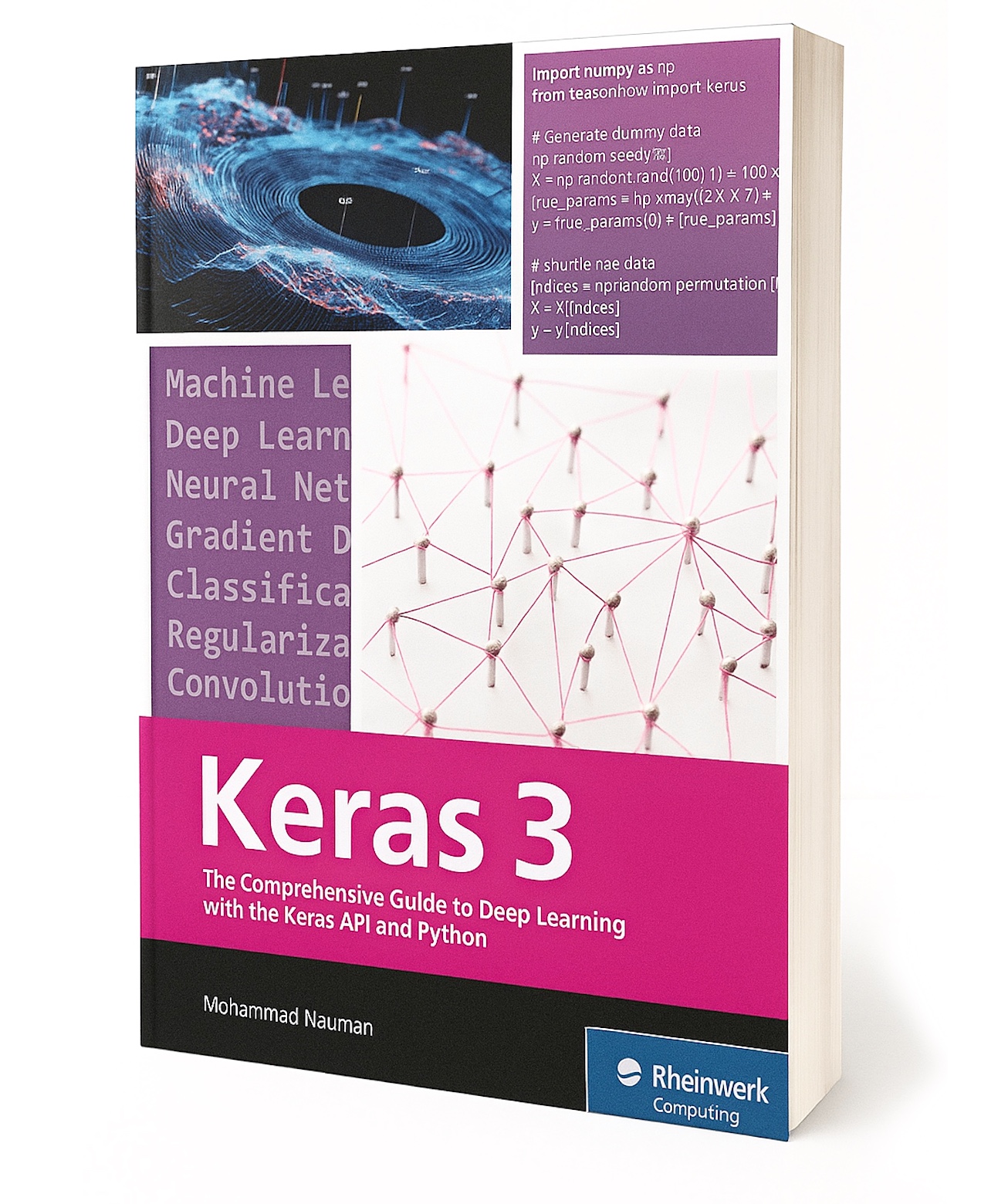
Keras 3
The Comprehensive Guide to Deep Learning with the Keras API and Python
This book lays the foundation for practical deep learning development, beginning with core machine learning concepts and gradually building toward sophisticated neural network architectures. Whether you're a beginner seeking to understand the fundamentals or an experienced practitioner looking to stay ahead of the curve, this guide offers clear explanations, practical code examples, and hands-on projects that will enhance your deep learning journey.
Throughout our journey in this book, you'll encounter snippets of code that demonstrate key concepts. Don't worry if some of the code examples in the first few chapters look complex or unfamiliar -- they're not meant to be fully understood right away. Think of them as windows into the practical world of machine learning, giving you glimpses of how theoretical concepts transform into working solutions.
As we progress through the book, we'll dive into the internals of Keras -- the powerful tool that makes much of this code possible. That's when these initial code examples will start to click into place, like puzzle pieces finally finding their home. You'll begin to understand not just what the code does, but why it's written that way.
Download Instructor Slides
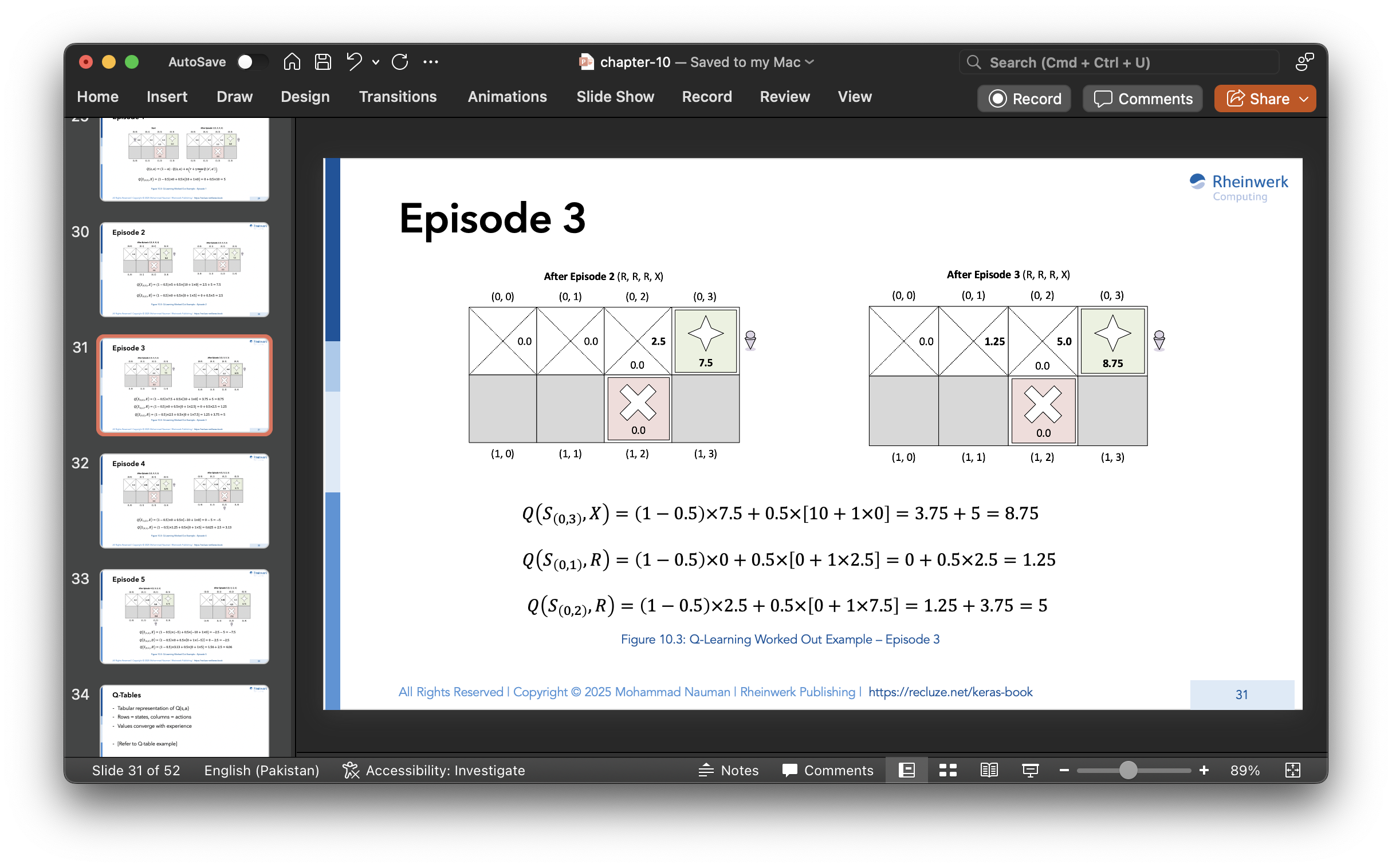
Table of Contents / Resources
In this chapter, we'll explore some success stories of deep learning, discuss why Keras is the ideal framework for learning this impressive technology, what you can expect from this book's comprehensive journey, and how to use it most effectively to build your expertise.
Sections:
- 1.1 Overview of Deep Learning
- 1.2 Why Keras
- 1.3 The Structure of This Book
- 1.4 How to Use This Book
At its core, machine learning is about finding patterns in data and using them to make decisions. In this chapter, we'll explore the fundamental ways machines can learn - through direct instruction with examples, by discovering patterns on their own, or through trial and error. We'll see how these approaches mirror learning in the natural world, and we'll begin to understand the powerful systems that make this learning possible. By the end, you'll be ready to start experimenting with these ideas yourself.
Subsections:
- What is Machine Learning
- Types of Machine Learning
- The Magic Sauce: Reinforcement Learning
- Basics of Neural Networks
- Setting Up Your Environment
- Summary
Resources:
Gradient descent is the cornerstone of modern machine learning, powering everything from simple predictions to complex AI systems. In this chapter, we'll build this fundamental algorithm from the ground up. This deep, foundational knowledge will serve as a guide to help you recognize how even the most advanced models are built on top of these guiding principles.
Subsections:
- Understanding Gradient Descent
- Types of Gradient Descent: Batch, Stochastic, Mini-Batch
- Learning Rate and Optimization
- Implementing Graident Descent in Code
- Summary
Resources:
In this chapter, we will build increasingly sophisticated models on top of our current understanding of regression. We will discover how to make yes-no decisions using logistic regression and then expand our capabilities to handle multiple categories simultaneously. Along the way, we will encounter essential concepts like softmax probabilities and cross-entropy loss. Through this journey, we will see how the humble task of drawing lines through data points evolves into systems capable of making nuanced decisions across multiple categories, setting the stage for more advanced applications in neural networks.
Subsections:
- Classification Basics
- Non-Linear Relationships and Neural Networks
- Binary vs Multi-Class Classification
- Loss Functions: Cross-Entropy
- Building a Classifier with Gradient Descent
- Summary
Resources:
In this chapter, we will finally dive deep into Keras. After examining the core technologies that power Keras, we will construct a practical image classifier that distinguishes between cats and dogs. Through this hands-on project, we will implement each essential component of the machine learning workflow: data preparation, model design, training, evaluation with multiple metrics, and model preservation. By the chapter's end, you will have mastered the fundamental patterns that form the foundation for all your future deep-learning projects.
Subsections:
- Introduction to Keras Framework
- Setting Up Keras
- Building Your First Model
- Implementing Core Concepts in Keras: Gradient Descent and Classification
- Summary
Resources:
In this chapter, we will explore the critical challenge that every machine learning practitioner faces: creating models that generalize well beyond their training data. We will learn how to identify when our model is too complex or too simple. By the end of this chapter, we will have acquired essential tools for building neural networks that capture meaningful patterns without being led astray by noise in our training data.
Subsections:
- An Overview of Overfitting and Underfitting: Do You Need More Data?
- Dropout: Concept and Implementation
- Other Regularization Methods: L1 and L2 Regularization, and When Not to Use Them
- Applying Regularization in Keras
- Summary
Resources:
In this chapter, we'll explore Convolutional Neural Networks and their revolutionary impact on computer vision. We'll investigate how convolutional layers detect patterns while minimizing parameters and we'll also explore some other types of commonly used layers. Through our case study, you'll see how these components unite into a powerful image classification system, gaining the intuition needed to design effective CNNs that process visual information similar to our own visual systems.
Subsections:
- Introduction to CNNs
- Convolutional Layers, Pooling Layers and Fully Connected Layers
- Implementing CNNs with Keras
- The “Shapes” Problem
- Case Study: Image Classification
- Summary
Resources:
In this chapter, we'll explore the Keras Functional API, moving beyond the limitations of sequential models to build complex neural architectures with explicit layer connections. We'll introduce powerful design patterns including residual networks with skip connections and multi-branched models that process information along parallel pathways. Through practical case studies, we'll implement cutting-edge applications like ResNet for classification, Siamese Networks for similarity learning, and U-Net for image segmentation. Finally, we'll master transfer learning, a technique that lets us repurpose pre-trained models for specialized tasks with minimal data and computation. By the end, you'll understand how the Functional API transforms Keras from a simple tool into a platform for implementing sophisticated architectures that achieve superior performance across diverse domains.
Subsections:
- Overview of Keras Functional API
- Building Complex Models with Functional API
- Use Cases and Examples
- Using Transfer Learning to Customize Models for Your Organization
- Summary
Resources:
In this chapter, we will explore transformers, a revolutionary architecture that has redefined natural language processing. We'll begin with the theory behind how these models understand relationships between words, regardless of their position in a sequence. We'll learn about key components like attention mechanisms that make these models so effective. We'll then build a transformer from scratch in Keras before showing you how to leverage pre-trained models to create practical applications with minimal code. By the chapter's end, you'll understand both transformer fundamentals and how to apply them to real-world problems.
Subsections:
- Theory Behind Transformers
- Components: Attention Mechanism, Encoder, Decoder
- Implementing Transformers in Keras
- Case Study: Large Language Model Chatbot
- Summary
Resources:
In this chapter, we will explore how machines learn optimal decision-making through trial and error. We'll examine the core concepts of agents, environments, and reward signals, and introduce key algorithms including Q-learning, and Deep Q-Networks. Using Keras and Gymnasium, we'll implement these techniques while balancing exploration and exploitation. The chapter will highlight crucial innovations like experience replay and target networks that have transformed reinforcement learning into a practical tool for complex problems. We'll also connect these concepts to the large language models discussed in the previous chapter, demonstrating how reinforcement learning techniques serves as a backbone for these powerful systems.
Subsections:
- Introduction to Reinforcement Learning
- Key Concepts: Agents, Environments, Rewards
- Popular Algorithms: Q-Learning, Policy Gradients, and DQN
- Implementing Reinforcement Learning Models in Keras
- Reinforcement Learning in Large Language Models
- Summary
Resources:
In this chapter, we will explore generative AI models that create new data from learned patterns, marking our transition from discriminative models that classify inputs to generative models that produce outputs. Along with transformers, generative models represent one of the most important technological foundations driving the current AI revolution, enabling everything from artistic creation to data augmentation. We'll progress from autoencoders through Variational Autoencoders to Generative Adversarial Networks, building the foundation for understanding modern generative AI.
Subsections:
- Introduction to Autoencoders
- Variational Autoencoders (VAEs)
- Generative Adversarial Networks (GANs)
- Summary
Resources:
In this chapter, we'll tackle one of the most exciting frontiers in modern AI: Stable Diffusion. You'll start by exploring the mathematics behind diffusion processes, understanding how computers learn to transform random noise into visual art and build your own diffusion model from scratch, watching it evolve from chaotic pixels to recognizable images. You'll uncover the secret behind "Stable" Diffusion and explore text-conditioned generation, where written words enable creative visual expression. Finally, you'll briefly consider sophisticated techniques like inpainting, where you control image generation with precision. By the end of this chapter, you'll understand how these systems work and how to harness their power for your own projects.
Subsections:
- Theory Behind Stable Diffusion
- How Stable Diffusion Utilizes Core Concepts
- Implementing Stable Diffusion Models
- Case Study: Image Generation
- Summary
Resources:
This chapter serves as both a celebration of your learning journey and a compass for the road ahead. We'll explore where deep learning is heading, discover practical strategies for staying current with rapid developments in Keras and AI research, and develop skills for following cutting-edge research. Most importantly, you'll gain the mindset and tools needed to transform from a student of machine learning into a practitioner who can adapt and grow alongside this quickly evolving field.
Subsections:
- Future Trends in Deep Learning
- Tips for Staying Updated with Advancements
- Following the Latest Research
About the Author
Dr. Mohammad Nauman
PhD in Computer Science, PostDoc in Machine Learning